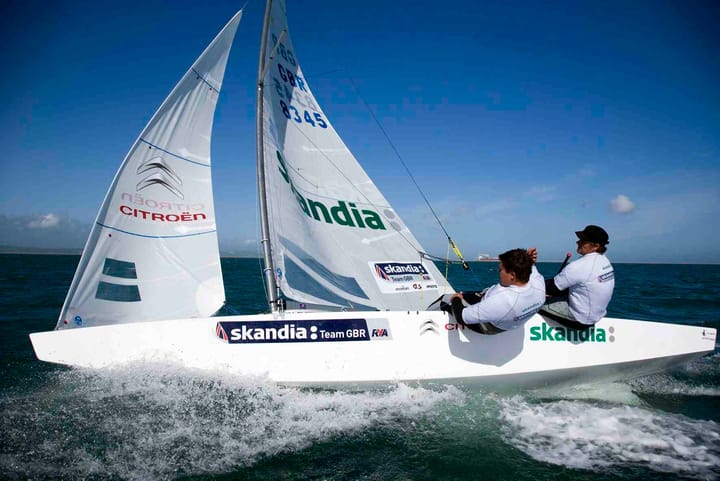
Pre-Start Prep with Olympic ace Giles Scott
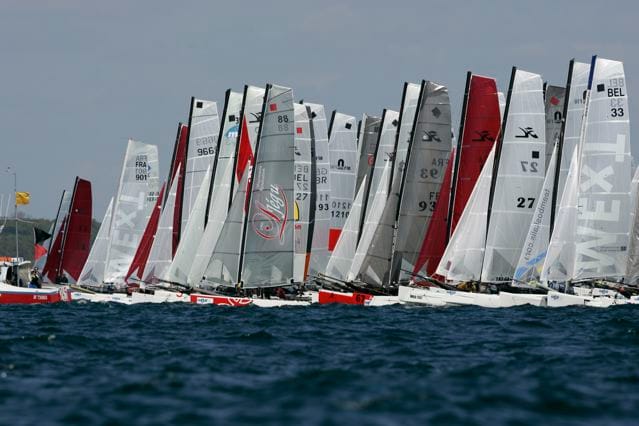
How to maximise your time before the gun for a fast start
Routines, routines, routines. The key to mastering a complicated sport is to make things simple wherever you can. For the competitive sailor, the start is the most critical period of the race, where a couple of seconds and a metre of advantage can add up to an enormous time and distance advantage further up the race track. So, as much as possible, you want to bring a form of organisation, a system, to the chaos of a busy start line. Which end of the start line is favoured? That’s an obvious one, but more importantly and less obviously, which end of the start line will put you in the best position further up the first beat? For example, if the right-hand side of the course is heavily favoured then nailing a pin-end start is only going to be useful provided you can tack and cross the fleet soon after the gun fires. So we asked top professional sailor Giles Scott about his pre-start routines and where he sets his priorities in the build-up to the most important moment in the race...
What’s your ideal preparation going into the pre-start period?
Work out your shift range, so I’d normally do that by sailing an upwind leg and just dial into the compass numbers. Get your sail choices and your rig set-up properly dialled in for the conditions. Then I would keep it all relaxed, have a drink, have some food. As soon as the start line is in, work out which end is biased, speak to your coach about any strategy, is there any tidal flow influence, forecast knowledge that you need to know. That would provide the foundation for your start strategy which leads to your race strategy. And then closer to the start, double check the bias and then decide how risky you want to be in nailing the biased end. If there’s a transit to get on the shore, make sure you’ve got that, because it will give you the confidence to be that much closer to the line. Also bigger boats where you tend to have GPS and electronic aids on board, the navigator will generally ping both ends of the line which gives you even more accuracy.
What if you’re racing with a crew that hasn’t done a lot of time together?
Sailing singlehanded compared with sailing with a crew has some obvious fundamental differences, and as soon as you’re working in a large group of people, you need to be able to communicate effectively. Especially in the fast boats, noise is a problem and clear comms is absolutely critical. It’s really important to be clear and use words that everyone is expecting. Communication is nearly always the biggest discussion point of any debrief, so it’s really important to make sure everybody on the boat understands what’s about to happen before any key moment. As a tactician I’d use the time before the start to brief the crew on a rough plan for what we want to be able to execute, whether it’s go left or right, or start midline and take the shifts up the middle.
What changes if it’s a downwind start?
The basics are very similar, just that with a downwind start the timing of when to hoist the chute is normally when it’s won and lost. Also having the ability to clear yourself if you don’t quite have the perfect start is tricky. Even if you do get a good start downwind, quite often if you extend you will then be drawn back into the main pack, because you are going into a position of having your wind covered. This applies more in yachts than in fast cats where the fundamentals of apparent wind change so much. But in slower yachts, you need an option to be able to clear out and clear your air. In fact for a downwind start I would put more of a priority on being able to clear your air than getting the line bias right.
What if there’s current involved, taking you over or away from the line?
I will have a look at the layline for the favoured end and how the current is affecting it, and I’ll keep an eye on the transit and see how it’s moving. You need to gauge how quickly you’re drifting on the current, because it affects your time-on-distance massively. The stronger the current, the important it is to do your dummy runs and timed runs at the line.
How much of a ‘Plan B’ do you have in case ‘Plan A’ doesn’t work?
My tendency is to focus only on Plan A, but if there is an obvious next move, make sure that this is known to the rest of the crew. The key is having a good group of sailors where everyone is able to change very, very quickly because obviously you don’t always execute your plan perfectly. That’s the key to a good sailing team; everybody on the boat is ready for a snap change of plan.