Stevie Morrison: Nail your Leeward Mark rounding
Get in and out of the leeward mark at max speed
STEVIE MORRISON represented Great Britain twice at the Olympic Games in the 49er, as well as winning the World and European Championships. These days the Exmouth sailor is much in demand on sportsboat circuits like the J/70, as well as for his expert TV punditry in SailGP...
INTRO
Whether it’s a single leeward mark or a leeward gate, this part of the race course offers a huge opportunity for making gains through the fleet - or losing an enormous number of places if you get it wrong. One of the worst things you can do - especially in boats with asymmetric gennakers - is gybe too soon above the final layline to the bottom mark. This leaves you with no choice but to go low and slow, and also makes you vulnerable to other boats coming in behind you at faster angles. They are likely to call ‘water’ on you, leaving you with no choice but to travel the great circle route around the mark, which will now position you in a wall of dirty air on the next windward leg. To avoid that doomsday scenario, Stevie Morrison offers five of his best tips for getting ‘fast in, fast out’ of the leeward mark.
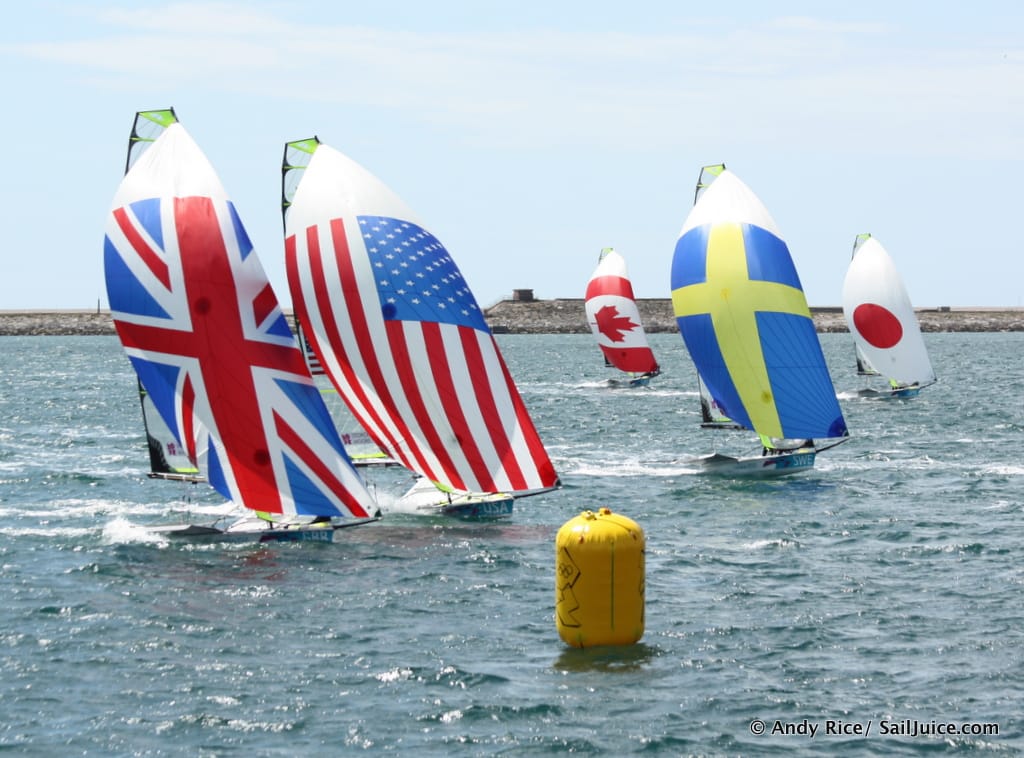
SET UP EARLY
Which side of the next windward leg do you think is favoured? Those are the kind of conversations you should be having after you’ve hoisted the kite at the windward mark. If you are aiming for a leeward gate, it’s surprising how early you have to set yourself up for your chosen side. By halfway down the run you want to make sure you have positioned yourself to be able to execute that final approach into the leeward mark. Your goal is to be approaching the three boatlengths circle with inside rights on all the boats around you. If you have inside room with rights, then you have by far the best opportunity to exit the mark and begin the next windward leg with a clear lane and lots of clean wind.
AIM FOR THE INSIDE
You need to fight hard for the inside rights at the mark, because a lot of others around you will be wanting the same thing. Practise your layline calls before the race so you have an accurate sense of where that layline will be during the race. This can vary a lot in different conditions, depending on wind strength and what current is flowing across the course. You want to be looking to hit the edge of the three boatlengths circle, giving you room to round the mark ‘wide in and tight out’. One thing we practised an awful lot in the 49er, and it applies to any small boat including sportsboats like the J/70, is the ‘gybe gybe drop’. This enables you to come into the leeward mark above the layline for the three boatlengths circle; the two quick gybes in succession makes it almost impossible for anyone to react, because you’ve broken any overlaps with your transom and gives you rights to round inside everyone. This is a hard manoeuvre to execute, which is why we practised it a lot. It’s a great one to have in your armoury. Another thing to think about in a boat like the J/70 is the option to goosewing the last few boatlengths on a dead run.
DON’T RULE OUT THE ‘WRONG’ MARK
When [Olympic medallist and America’s Cup helmsman] Chris Draper was coaching us, his big tip was to look behind you on the run to see where the bulk of the fleet is positioned. Sometimes it’s worth going around the mark that will give you the clearest lane away from all the bad air coming from the boats behind you. This could well mean sailing further to the less favoured mark if the gate is skewed. Here’s another scenario where you might sail to the ‘wrong mark’; if there is an obvious favoured side of the windward leg, then there will be a lot of traffic around that mark. The leaders will go round in clear air but if you’re back in the pack, consider going around the opposite mark of a leeward gate. You can put in a short hitch upwind and, when you’ve got a clear lane through the downwind traffic, tack across. Now at least you’ll be in your own lane of clear air rather than fighting for a thin lane out of the other mark. Obviously a lot of these decisions come down to the speed of your boat. The more high performance the boat, the more it becomes worth considering going the further distance for clear air.
GET INTO HIGH MODE ASAP
Whenever you go training, make sure you don’t just sail in your standard VMG mode; practise your high pointing and low footing modes. One of the critical areas for applying these different modes is out of the leeward mark. Most of the time your default mode out of a leeward mark is high mode, so much so that everyone on the crew should know this without it needing to be said. If you’re ahead, you want to make it hard for the boats behind to pass you to windward. But if you’re behind, you want to fight with all your might for the high lane. The moment you slip into someone’s dirty air is the moment life gets much harder. If it’s a long windward leg and a long way to the next tack, then it might be worth footing out and yielding a bit of windward ground in the short term for a longer gain in clearer air. Also, don’t underestimate other people’s lack of patience. Sometimes clear air can open up in front of you when others get frustrated with sitting in bad air. Of course, if you’re in a boat that doesn’t lose too much on the tacks, then maybe it’s worth putting in two quick tacks to clear your air and get back on to the favoured heading again.
GET ON THE RIGHT SIDE OF THE TIDE
When the current is running upwind and you’re fighting it sailing downwind, consider keeping your spinnaker up for longer than usual, particularly in light winds. Racing in the J/70s at the J Cup, a bad tactical call had meant we were poorly positioned for the mark rounding. But it was light winds and we kept the gennaker up until the transom was past the mark, passing all those that had dropped early and were barely making ground against the tide. Even if your rounding’s a bit scrappy, it’s worth the sacrifice if gets you sooner on to that upwind, uptide conveyor belt. On the other hand, with current sweeping you downwind, much better to get your kite down earlier than you think. The worst scenario here is to be still dropping the kite as you’re being swept past the mark. Without question, others will be caught out like this. Don’t be one of them. Drop early and claim the higher ground on the next upwind leg.