Sam Davies: Toughing it through a Cold Front
TOUGHING IT THROUGH A FRONT
SAM DAVIES is one of the most accomplished offshore racers in the world. A former skipper in the Volvo Ocean Race and competitor in multiple editions of the Vendée Globe, the British sailor is a respected veteran of the ocean racing scene.
INTRO
Weather fronts mark the boundary or transition zone between two air masses of different temperature, and represent one of the most predictably tough and challenging parts of any offshore passage. Getting through them safely and with boat and crew intact is vital for any cruising or racing sailor. With four circumnavigations of the globe and around 30 transatlantic crossings in her logbook, British sailor Sam Davies has more experience than most of the right way - and the wrong way - to tackle this meteorological obstacle course. Here the professional racer shares her best tips on not only how to get through the front as safely and as comfortably as possible, but to do so in such a way that gets you out ahead of the opposition.
1. ONE GOOD FORECAST
Don’t waste precious time and energy during the build-up to a front getting multiple, detailed forecasts. But absolutely DO make sure that you get the best possible, most up-to-date forecast that you can, with as much detail as possible. The later you leave your weather forecast the more likely it is that you'll get an accurate time when the front is going to come through. With the right information you can time its arrival to the nearest hour. If you have access to a satellite phone, then not only can you get even more up-to-the-minute information but the satellite photos are useful for telling you how violent the front is likely to be, and the kind of conditions that you can expect after you've gone through the front. Sometimes even when you’ve passed through the front, you can still get massive squalls of 50 or 60 knots on the other side, and the photos will give you a good idea of the characteristics of the front you’re about to enter. If you can see lots of small white dots around you on the satellite photo, then you know that the gusts are likely to be quite big. Once the satellite photo shows that you're in an area where there the dots are a bit more grey and fewer of them, then you know that you're through the worst of it.

2. BATTEN DOWN THE HATCHES!
When it comes to preparing the boat for fronts and making all the necessary changes such as putting in reefs, you mustn't be too intimidated, and don't do it too soon. Equally you mustn't leave it too late, because that can be disastrous. Don't try to be to macho and think that you can hang on to that big sail for longer than other people. Otherwise you’re at risk of reaching the point where you can't take the sail down because it's got too windy. Sometimes the front can be so severe that it might break the boat. Once you know the timing of the front and the likely severity of the conditions, it's about the management of how you go into it. Maybe you’ll even need to sail in the wrong direction to preserve the boat in a big sea state. In terms of sail preparation, know what kind of reefs you're expecting to take in, and make sure that you get those reefs in before the worst of the weather hits. On an IMOCA 60, we can spend quite a long time tidying away our reefs, because if you have a big pocket in the reefs you can end up catching a lot of water in it, which is slow and potentially could overload and break equipment.
3. GET YOUR CREW READY
The more well rested you are, the more safely and effectively you'll get through the front. If you know you might get seasick, then make sure you've got the right drugs on board to help you with that. If in doubt, take the seasickness pills anyway, because you need to be at full strength for dealing with the front. Do all the tidying up down below and get as many of the below-decks chores like cooking done in advance. Make sure that your food is well prepared so that when it's rough you don't have to boil water; get out snacks in advance so you not having to hunt through bags. All that stuff needs to be ready before the front hits.
4. BE PREPARED FOR THE SHIFT
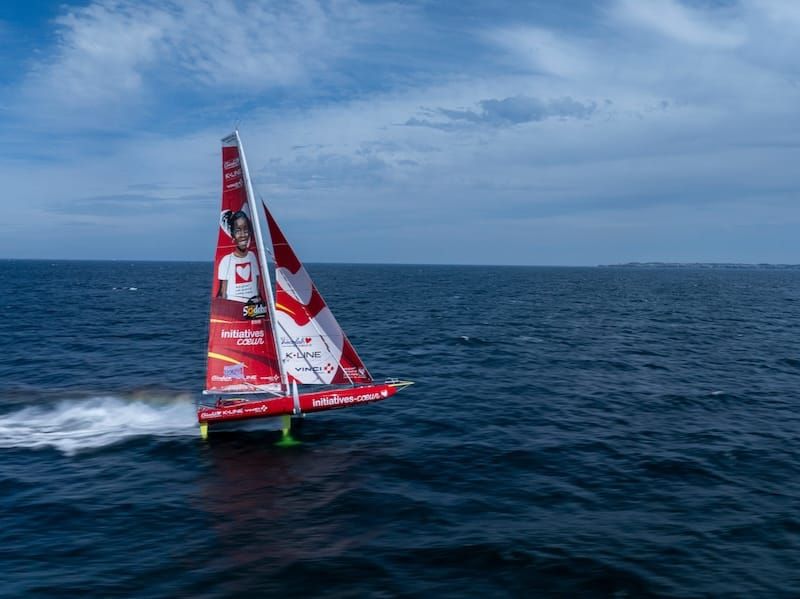
Last year when we were racing Initiatives Cœur doublehanded in the Transat Jacques Vabre, we could see that the front was going to pass really quickly, and that it was going to be quite ferocious when it hit. There’s usually a significant wind shift immediately after a front, and we knew that we would want to tack quite quickly once the front arrived. So, especially if you’re sailing short-handed but even if you’re fully crewed, it’s a good idea to re-stack the boat and move all the gear across down to leeward, letting gravity help with the workload before you tack the boat. For this reason we were careful to get our weather forecast as precise as possible so that we could begin the stacking to leeward just before the front hit. You might end up sailing with the stack to leeward for 10 minutes also, and with the balance out, but as soon as the shift comes you can be on the right tack, going fast. You can monitor the arrival of the rain, and the growing intensity of the rain, to give you an idea of the timing of the front.
5. FAST OUT THE FAR SIDE
Sometimes the biggest gains come just after you've broken through the front. Quite often getting through the front can feel like an anticlimax and sometimes people are slow to change gear and get the boat back up to full speed. Maybe it’s because the adrenalin drops and people are tired; which is why it’s important to manage your boat and your crew to sail slightly conservatively during the front so that you’ve still got the energy to make the big gain afterwards. Be ready to attack and go on the offensive as soon as you're out of the front.