Venue Guide: Torbay
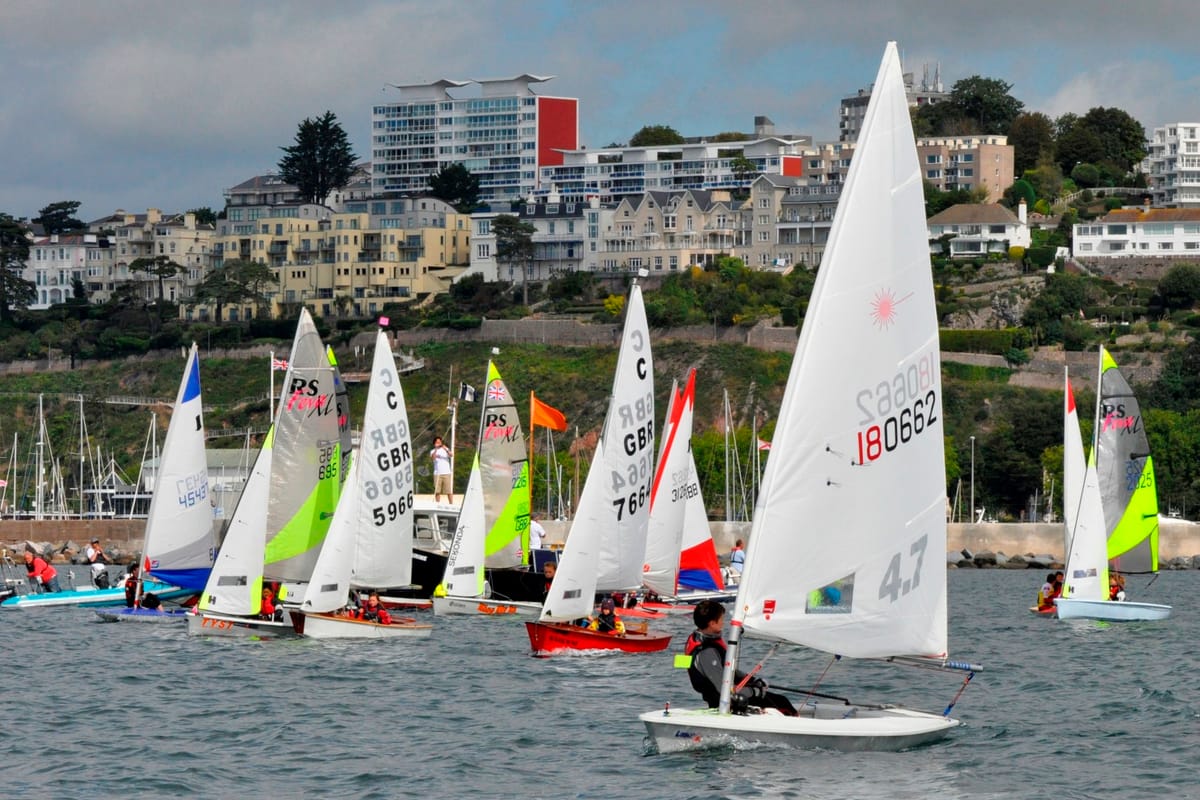
Torbay is a large bay, facing east and situated on the English Riviera. It is
one of the most popular venues for major yachting events in Great
Britain. The venue is serviced by three clubs: Royal Torbay Yacht Club to
the north; Paignton Sailing Club in the middle; and Brixham Yacht Club to
the south.
All three clubs have an excellent reputation for hosting major events.
They offer first class hospitality, a friendly atmosphere and a professional
approach to the running of big events, both ashore and afloat. But book
early to save disappointment, as it is a very popular venue.
Race Areas
The three race areas could operate easily at any one time: north, middle
and south in the bay. However, if there is just the one major event going
on at one of the clubs, then they normally plum for the middle of the bay,
or the area nearest to the club hosting the event.
North Race Area
Wind Direction
330-040 degrees: 'Orrible direction for Torbay, with the wind coming
over the top of a high land mass to the north it is all over the place. This
is both a competitor’s and a race committee’s nightmare. Should you
have to race in this wind direction, don’t forget to take the prayer book
with you! The wind shifts over a wide arc - perhaps 80 degrees. Worse,
the wind is very gusty as it comes over the top of the hill. Normally, the
race committee will not race you here. They will take the fleet further to
the south or east, away from the land for cleaner wind.
040-090 degrees: A clearer direction for the wind and also for the sea.
The wind coming anywhere from the eastern sector will give you the
roughest sea state, with big waves and swell having gathered momentum
along the English Channel. It normally pays to go left up the beat for the
wind, as there is more velocity on the left, as well as the header on
starboard tack as you go in towards the shore, with lifts as you come out
on port tack.
090-140 degrees: This is the clearest sector for the wind, whilst racing in
the northern circle in the bay. The wind now tends to be more stable in
both direction and velocity. So the tidal scenario will play more of a role
in the decision making process, which we will address later.
140-270 degrees: We are once again land locked and back into the shifts
mode, however, even this sector for the wind can be broken down into
smaller sectors:
140-220 degrees: In this sector, the wind is not too bad in terms of
direction and velocity, as you are quite some distance away from any high
land mass. The shifts are over a narrow arc - 10 degrees, with not too
much change in velocity. Know your numbers on the compass, highs and
lows, as on starboard tack with the wind in this direction, there is no land
for reference.
220-270 degrees: Use the shifts left-of-middle, where you will find
more velocity in the wind. If you get too far over to the right too early,
you will find less wind on that side of the course.
270 degrees: In the northern circle with the mean wind at 270 degrees, it
once again pays to work the shifts left-of-middle, because of the
divergence - a lighter wind band along the northern shore line.
270-330 degrees: With the wind now in the north-west sector coming
over relatively high ground, it’s back into the shifty/gusty mode. Once
again, know when you are high and low on either tack, and keep your
eyes more out of the boat, looking for the gusts and shifts.
Middle Racing Area
Normally positioned due east of Paignton, this race track is the furthest
from the land to the north and south.
Wind Direction
330-040 degrees: From this sector, the wind is still in the shifty mode.
So use the shifts, but work the course left-of-middle, looking for the
increase in wind in the convergent band to the left. In the top left hand
corner of the course, you may find a lift on port tack, on or near the port
layline, so be careful not to overstand the mark.
040-140 degrees: This is the clearest direction for the wind and the
roughest for the sea state. We have raced in some big waves and swells
when the wind is in the eastern sector - exciting stuff! The wind is at its
most stable in both direction and strength, no great gains either side of
the course, tide may be a factor now, which we will look at later.
140-180 degrees: Facing the wind direction, we now have the land mass
on our starboard side. If you get close enough to it, there is less wind, so
you will need to be working the beat middle and left, for more wind.
180-240 degrees: Shifts again with the wind in the south-to-south-west
sector, with the land mass now predominantly on the starboard side.
Once again we should be working the shifts middle-to-left for more
wind, staying away from the divergence wind band on the right side of
the course.
240-330 degrees: Shifts again, watching for high and low numbers on
the compass. The shifts are more frequent and over a wider arc as you
get closer to the shore. Also, keep in mind that as you get closer to the
shore, if the windward mark is within half a mile of it, the first shift of
wind as it blows from land to sea is to the right, so look for more lifts on
port tack when you close with the land.
South Race Area (North of Brixham)
Wind Direction
330-020 degrees: Small shifts, coming off the northern shore, but small
and not that frequent. Do not tack on them unless they are large enough
to gain an advantage in the design of boat that you are in.
020-120 degrees: If the wind is a north-easterly, this is a rough part of
the bay with the backwash of waves coming back at you from the south-
west corner. This is the clear wind sector with the wind at its most stable
in both direction and strength.
090-140 degrees: Once again, we now have the land mass on the
starboard side of the course. That is the divergence side for the wind,
there’s less wind on the right, so work the beat middle-to-left to stay in
more pressure.
140-240 degrees: This is back to the shifts off the shore scenario, the
numbers game on the compass, heads out of the boat looking for the
shifts and gusts. We need to know which is the lifting tack out of the
starting area, and the same thing at the beginning of subsequent beats.
Don't forget that as you approach the windward mark area, there may
well be more lifts on port tack if the windward mark is within half a mile
of the shore.
240-270 degrees: We are still in a shifty sector for the wind. However,
the land mass is not only ahead of us to the west, it is also to the left and
south of us, creating a convergence area of wind. We should be working
the shifts on the left side of the course (looking upwind) in more
pressure. And looking for the header as you go in on starboard tack
towards the shore, with lifts on port as you come out.
270-330 degrees: A similar scenario to the above. Shifts, with more
pressure on the left side of the course upwind. There should be lifts on
port tack over on the port layline for the windward mark.
Sea Breeze
The signs for a sea breeze in Torbay are little or no gradient wind, clear
blue sky in the early morning, with a light, western sector wind. As the
land heats up, and the cumulus clouds develop, the sea breeze normally
comes in from 160 degrees (ish). Then backs slightly as it fills in. It then
follows the sun in the afternoon, ending up at around 240 degrees (ish)
in the evening. In the afternoon, protect the starboard side of the course!
Tide
The main flood stream flows from south to north across the face of
Torbay, and the ebb from north to south. In the bay, the flood tide may
have a clockwise rotation, with a back eddy anticlockwise along the
northern shore. During the ebb, there maybe an anticlockwise rotation
around the bay, with a clockwise back eddy along the southern shore of
the bay. All this being more so during spring tides, as there is not much
movement during neaps.